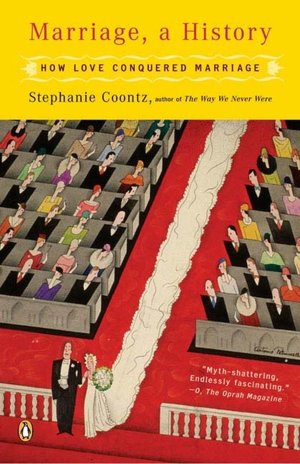
 After two months, I finally finished reading Marriage, a History: How Love Conquered Marriage
Central to any discussion of the history of marriage, I discovered, is an exploration of men and women?s changing roles through history. So a major topic of discussion in this book is the history of the male breadwinner and the female housewife.
This is a topic of great interest to me, as an educated woman who has recently chosen to be a stay-at-home mom (or SAHM, as I?m begrudgingly adopting for this post).
What intrigues me most about the the stay-at-home mom is the colossal variation in people?s feelings about her in Western culture today.
On the one hand, we have the deep sentimentalization of the SAHM. For some, the SAHM is the pinnacle of feminine self-sacrifice and love. She is honoured because she is so selfless and nurturing. ?In communities where the SAHM is idealized, moms who return to work are perceived as less loving and somewhat selfish, overly-preoccupied with money and status.
On the other hand, we face the equally pervasive notion that being ?just? a stay-at-home mom is degrading, menial, and a waste of a woman?s talent and intellect. Many SAHMs feel underappreciated and condemned for being weak-minded, unsophisticated, and slightly masochistic.
So which is it? Do we revere the SAHM or do we disdain her? Is SAHMhood a dignified life choice or a degrading one?
We seem to have very mixed feelings about her. And that?s why I?m intrigued by her history.
The History of the Housewife
Coontz begins by looking at the roots of marriage in human prehistory, when hunter-gatherer societies developed marriage as way to establish a socially-approved division of labour between partners. (She emphasizes that marriage also provided a way to establish cooperative relationships between in-law families, and allowed property and status to be passed down to the next generation in an orderly manner, but my interest here lies especially in divisions of labour).
Men and women have almost always done different kinds of work, women sticking with activities that enabled children to remain close to them. (This didn?t always mean women stayed ?home,? though: for hunter-gatherers, it meant carrying young children in slings as they walked over great expanses, gathering food. In farming societies, by contrast, husbands didn?t leave the home but worked the land alongside their wives.) The idea of ?different spheres? ? where wives are ?designed? to care for home and kids while the husband goes out to work for wages ? only emerged in the eighteenth century.
As Coontz explains, the male breadwinner model of organizing families developed with the spread of wage labour and the market economy. People began to insist on money for payment for goods and services in the eighteenth century, but it was not yet possible for a family to survive on cash alone. Since few commodities could be bought ready to use, most families still needed someone to specialize in household production (sewing clothes, growing and preparing food, etc) while someone else devoted more hours to wage earning. Enter the female housewife and the male breadwinner.
 During this time, a new sentimentalization of wives and mothers also emerged. Coontz explains that as housekeeping became ?homemaking,? it came to be seen as an act of love rather than a contribution to survival. This had a combination effect of re-valuing women but de-valuing their work: ?Women?s traditional tasks ? growing food, tending animals, dairying, cooking, and making clothes ? though no less burdensome, were no longer viewed as economic activities? (p. 153). Coontz explains: ?Homemakers, now cut off from the sphere of the cash economy, became more dependent on their husbands financially. Women?s diaries in the early nineteenth-century reflects a new self-doubt about the worth of their contributions to the household economy? (156). According to Catherine Kelley, women?s labor was ?radically undervalued in the world of cash transactions? (Coontz, p. 156).
So while housewives were highly romanticized, women in these roles were plagued with doubts about whether their work was really all that meaningful or important.
I think women today are faced with the same paradox: motherhood is sentimentalized, and yet mothers have misgivings about the value of their work.
Housewives Today
I was especially intrigued by another of Coontz? observations:
Today . . . stay-at-home mothers are concentrated in the poorest and richest rungs of the population. The only two segments of the population in which male breadwinner families predominate are the bottom twenty-five percent of the income distribution and the top five percent. (p. 295)
These two different kinds of stay-at-home moms have very different statuses.
Coontz explains that in the high-income male breadwinner marriages, ?wives usually have the resources and time to develop skills that earn them respect from their communities and their husbands even though they don?t bring in income? (p. 295).
In the low-income families, though, mothers stay home because they don?t have enough money to pay for things like child care or a second car or suitable clothes to allow her to work. Moreover, the kinds of jobs available to these women typically don?t pay enough for the family to recoup these costs (295).
That would help explain our mixed feelings about stay-at-home moms: for some, staying home represents a luxury that enables the woman to develop valuable social skills; for others, it?s something they?re forced into.
Now that I?ve explored our culture?s varying attitudes towards the stay-at-home mom, I want to explore my own feelings and experiences in the next post.
Stay tuned for the story of my path to becoming a stay-at-home mom. Exclamation mark!
What kinds of attitudes have you come across in regards to mothers who stay home? Have they been mostly negative or positive? How has that influenced the way you hope to organize your family life?
Source: http://projectmonline.com/2012/01/31/the-stay-at-home-mom-a-love-hate-relationship/
lord monckton lord monckton andy kaufman october 21 2011 ohio ohio john beck

No comments:
Post a Comment
Note: Only a member of this blog may post a comment.